
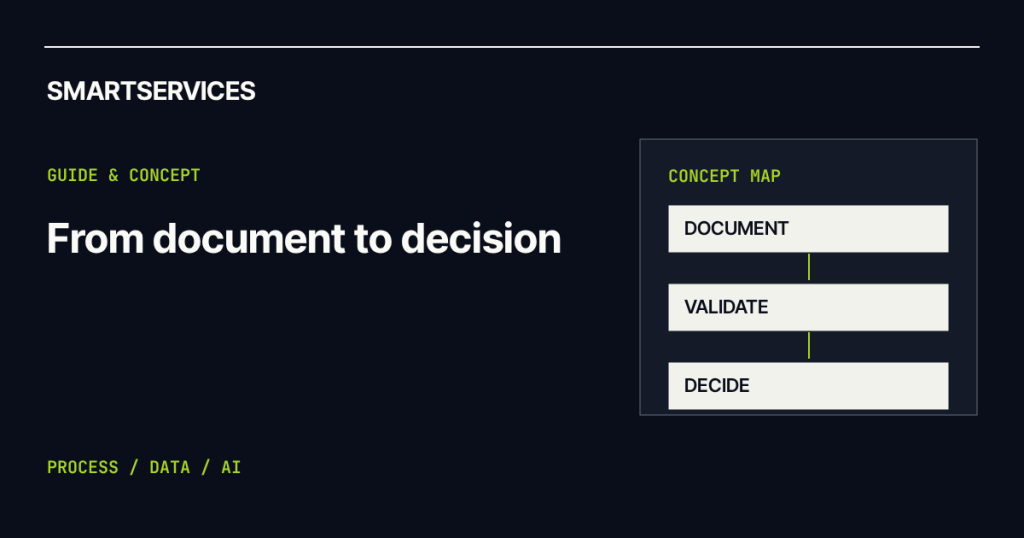
Short answer
Optical Character Recognition (OCR) identifies text in images and scans. If an invoice arrives as a photograph, OCR may read its number and amount. That does not prove the number belongs to the right vendor, the amount matches a purchase order, or the invoice should be paid. Reading and deciding are different steps.
In one sentenceOCR recognizes document text; document intelligence adds structure, extraction, validation and workflow decisions around that text.
OCR turns a document image into text
Product labels are not rigid boundaries. Some OCR tools also identify layout, tables, and key-value pairs. Compare actual capabilities rather than names. The operational question is what information is extracted, how it is verified, and what happens next.
Follow the document-to-decision path
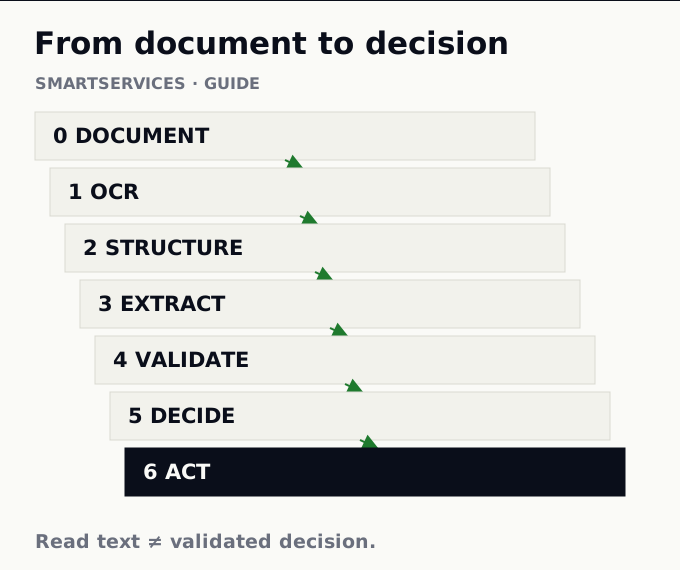
A document workflow can move through seven stages: document → text → structure → extraction → validation → decision → action. Text says “Invoice 381.” Structure identifies a header. Extraction stores an invoice number. Validation checks vendor, purchase order, tax and amount. A rule or person decides whether to accept it; a system records the outcome.
This “document-to-decision pipeline” is an explanatory model, not a formal industry standard. It makes failures visible. Excellent character recognition does not help if the final decision uses the wrong vendor.
Structure, classification, and extraction
Layout analysis identifies paragraphs, cells, tables, and positions. Classification distinguishes an invoice from a purchase order, contract, or claim. Entity extraction finds a date, tax ID, document number, currency, or amount. A field can be absent, duplicated, or written in a note. Keep evidence of where each value came from.
A language model can help interpret free text and varied layouts. It should not invent a missing field to complete a row. When financial or legal effects matter, extracted values need rules, master records, and sometimes human review.
An invoice that looks successful but is not
Hypothetical example: OCR reads “Invoice 381, $120,000.” The vendor exists, but the purchase order allows $102,000. A sound workflow does not report success just because it read the characters. It checks tolerances and creates an exception. A duplicate invoice should be held. A missing purchase order should trigger a request for information. The action follows the business process, not an OCR confidence score.
The same pattern applies to claims and contracts. A contract may mention one date in a clause and another beside a signature. Selecting the first date found is a weak rule. An email may contain a new request and a quoted old request; they are not the same instruction.
Measure the pipeline, not just OCR accuracy
Measure readability, field extraction, validation, human intervention, and operational outcome separately. Character accuracy is not end-to-end process quality. Time per document, exception-review cost, and traceability also matter. Test new documents, not only the samples used to configure the system.
Full automation may be wrong when critical fields are ambiguous, rules change often, or master data is inconsistent. The first work may be cleaning vendor records and connecting systems. Integration lets the extracted value be checked against operational data.
Frequently asked questions
Does OCR understand an invoice?
OCR reads text. Some products add extraction and classification, but business validation needs rules, data, and context.
Does document intelligence always use generative AI?
No. OCR, classification models, templates, rules, and human review can be combined according to the document and risk.
What if a PDF already contains text?
OCR may not be needed, but structure, extraction, and validation may still be necessary. A digital PDF is not automatically operational data.
How should unreadable documents be handled?
Use an explicit route: request a better copy, send for review, or stop the action. Guessing a critical value is not a control.
How Smartservices applies the distinction
Smartservices treats document intelligence as part of an operating process: input, trusted data, validation, exception, and action. It can work with automation, but the goal is a correct, traceable decision—not just more text.