
Short answer
Human-in-the-loop (HITL) AI places a person at defined points to review, approve, correct, or supply information. It does not require someone to inspect every step. Nor does an unattended queue become oversight because a workflow diagram has a human icon. A useful intervention has a reason, an owner, enough evidence, and a decision the person can actually change.
In one sentenceHuman-in-the-loop AI places human review, approval, or correction at defined points in an automated workflow.
Define the human role, not just the label
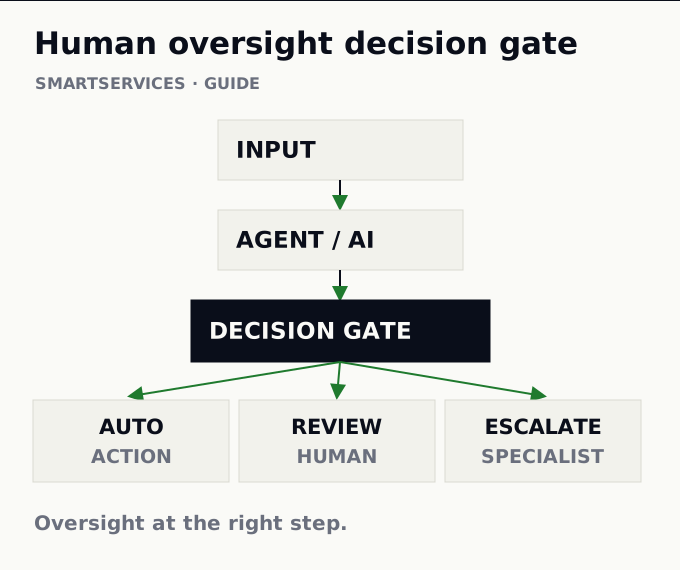
Routine cases can follow explicit rules. Cases with missing data, uncertain interpretation, or required authorization can move to a person. The human does not need to be in every step. They need to be in the right step.
Auto, Review, Escalate
These three paths are an operating model, not an industry standard. Auto executes within defined boundaries. Review holds a proposed action for human approval or correction. Escalate sends a case to a specialist when evidence is missing or the request falls outside scope. Each path needs a clear owner and an audit record.
Hypothetical example: an agent handles customer claims. It may confirm that an order exists and acknowledge receipt automatically. It may suggest a category for review when the text is ambiguous. It should escalate a request for an exception to policy or an irreversible action. A single “approve” button is a weak control if the reviewer cannot see the evidence or choose another outcome.
Oversight before, during, and after execution
Before the loop, people define allowed tasks, sources, permissions, thresholds, and prohibited actions. In the loop, the system pauses for review or asks for missing information. After the loop, people inspect samples and incidents to improve rules. These controls reinforce one another. A later audit cannot prevent an irreversible action that has already happened.
Model confidence is not business risk
A confidence score describes a model signal under particular conditions. It does not tell you the cost of being wrong. Sorting an email and authorizing a payment have different consequences at the same score. Comparing expected error cost with review cost is a useful design question, not a universal formula.
A single threshold can also hide rare, severe mistakes or cases unlike the test data. Use input quality, business rules, reversibility, and consequence alongside model scores. When evidence is missing, asking for more information may be safer than guessing.
Make review actionable
- Show the original input, proposed result, and relevant evidence.
- Allow correction, rejection, and return—not only approval.
- Record decisions and reasons without collecting unnecessary personal data.
- Measure how often review changes the outcome and how long it takes.
- Use observed mistakes to refine limits and test cases.
Poorly designed human review creates approval fatigue and false assurance. Agent metrics should include whether interventions help, not just how many occurred.
When full autonomy is the wrong design
There is no universal list, but strong signals include material effects on people, money, or access; hard-to-reverse actions; sensitive information; mandatory authorization; and errors a system cannot reliably detect. Define who remains accountable and how an action can be stopped or rolled back. NIST’s AI risk framework treats human roles as a contextual design decision.
Frequently asked questions
Must a person review every case?
No. Review may focus on exceptions, high-impact actions, samples, or an initial pilot period. The coverage should match the risk.
Does a human reviewer make an AI system safe?
Not automatically. The reviewer needs time, evidence, and authority to change the outcome. A rubber-stamp approval is not an effective safeguard.
What if nobody responds to an escalation?
The workflow needs a safe waiting state, an owner, and a time limit. It should not execute an unauthorized action by default.
Is HITL limited to AI agents?
No. A deterministic payment rule can also pause for a human exception decision.
Putting the boundary into a workflow
Smartservices separates automatic steps, reviews, and escalations while designing an AI agent or automation. Human responsibility is specified before a workflow goes live.