
Short answer
An Application Programming Interface (API) exposes operations or data that software can request. A webhook sends a notification when an event happens. Robotic Process Automation (RPA) drives a user interface intended for people. They are not always alternatives: a webhook can announce a sale and an API can retrieve its details before another system is updated.
In one sentenceAn API exposes operations, a webhook sends event notifications, and RPA drives a user interface.
Three mechanisms, different interaction patterns
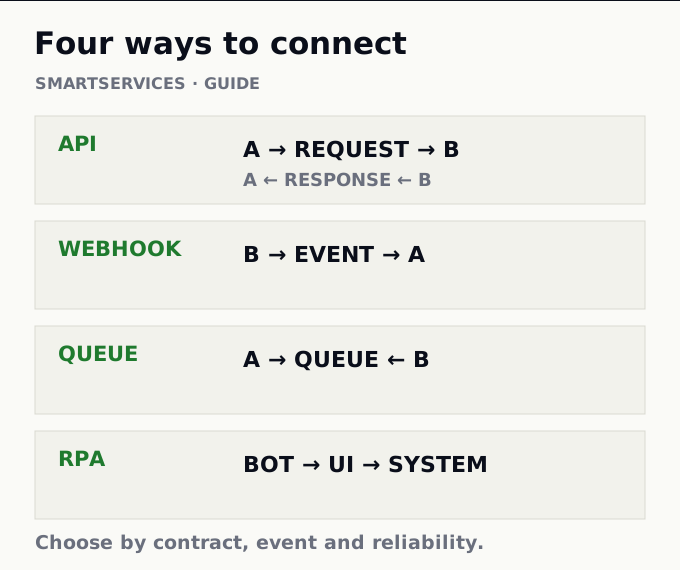
The quick model is API, “I ask or execute”; webhook, “the system notifies me”; RPA, “software operates the screen.” Files, databases, queues, and messaging services are other integration surfaces. Choose by available access, frequency, reliability, and maintenance cost.
API: request an operation through a contract
An API can retrieve a customer, create an order, or change a status through a documented interface. Representational State Transfer (REST) over HTTP is common but not the only form. Examine authentication, permissions, rate limits, versions, error handling, and the meaning of each operation. An HTTP 200 response does not by itself prove a business order finished correctly.
Repeated requests can create duplicate effects unless retry behavior is designed. Idempotency—retrying without multiplying the intended effect—matters for payments, orders, and account creation. Record a request identifier and the result that was returned.
Webhook: respond to an event
A webhook delivers a notification to a configured endpoint when something happens, such as “order approved.” It avoids polling an API every minute. The receiver still needs to verify origin or signature, handle duplicates, acknowledge promptly, and process work afterward. Events can be delayed or fail. Monitoring and reconciliation are part of the design.
A webhook is not a universal “exactly once” delivery guarantee. Retry policies differ by provider. GitHub, for example, documents failed deliveries that need manual or custom redelivery. For critical actions, confirm final state with the source system.
Queues, files, databases, and RPA
A queue decouples systems that need not be online together. A file can handle agreed batches when schema, validation, and receipt are defined. Reading a database may expose information, but writing directly into another product’s tables can bypass its business rules. RPA is useful when only a visual interface exists or a task crosses applications without a stable integration surface. It needs monitoring because screens, permissions, and controls change.
When a stable interface designed for integration exists, it is usually preferable to driving a human interface. That does not make RPA “always the last resort.” In some legacy environments it is a reasonable option with bounded volume and explicit controls.
| Mechanism | Trigger | Typical use | Main risk |
|---|---|---|---|
| API | Consumer request | Read or write data | Permissions, limits, versions |
| Webhook | Source event | React to a change | Delivery, duplicates, authenticity |
| Queue | Published message | Asynchronous work | Ordering, retries, visibility |
| File | Agreed batch | Periodic exchange | Schema and reconciliation |
| RPA | Bot or schedule | Operate a visual UI | UI changes and credentials |
One integration from event to outcome
Hypothetical example: a retailer confirms a sale. A webhook announces the event. A service uses an API to retrieve authorized details, checks the transaction ID, and publishes a message to update the ERP. A retry does not duplicate the sale. If the ERP has no supported integration but offers a stable screen, RPA may handle a limited subset; the design must detect failures and reconcile records.
Frequently asked questions
Does a webhook replace an API?
No. A webhook often says that something happened; an API can retrieve details or perform an action.
Is RPA always worse than an API?
No. Compare actual access, volume, stability, maintenance, and controls. The fastest prototype may not be the best operating choice.
What if an event arrives twice?
Recognize its identifier and avoid duplicating the effect, or use an idempotent operation and reconciliation.
Can legacy systems be integrated?
Yes, through the supported surface: API, web service, file, authorized database, queue, or visual UI. Understand its contracts before building.
How Smartservices connects systems
Smartservices works on systems integration and process automation. Publicly described experience includes SAP, Dynamics, e-Comex, APIs, Web Services, and legacy environments as technologies encountered—not partnerships or certifications. The connection follows the process and its controls.