
Short answer
Structured data follows explicit fields and types: customer_id, invoice_date, and amount can be columns in a table. Unstructured information does not naturally fit fixed predefined fields. Email, audio, images, and free text carry meaning without arriving ready for a SQL query. “Unstructured” does not mean useless or patternless; it means the relevant content needs interpretation.
In one sentenceStructured data follows an explicit schema; unstructured data does not naturally fit predefined fields.
The distinction is about schema, not importance
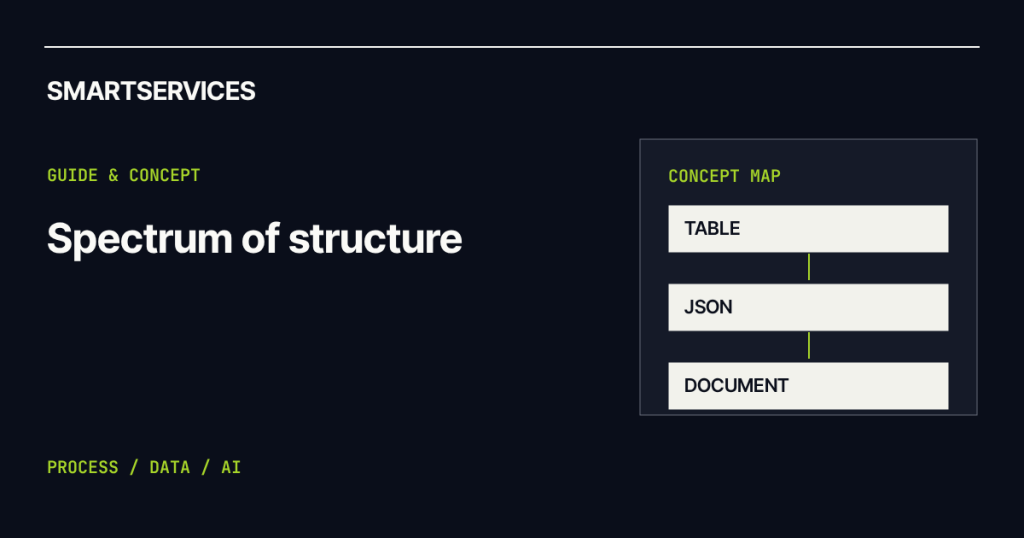
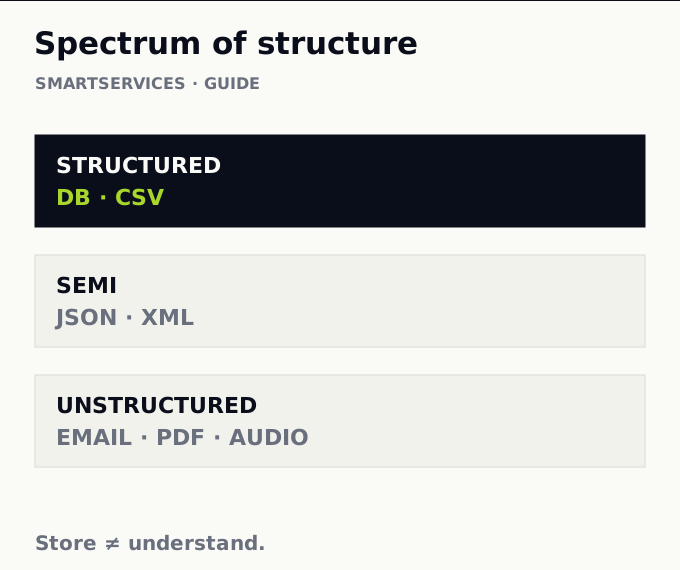
Semi-structured formats sit between the two. JSON, XML, and some logs contain keys or markers while attributes may vary across records. This is a common classification, not a universal boundary. JSON validated against a strict schema can behave like highly structured data.
A spectrum of information forms
| Form | Example | What is directly queryable |
|---|---|---|
| Structured | Invoice table: date, vendor, amount | Filters and calculations on defined fields |
| Semi-structured | Order JSON with optional keys | Known keys after validating variants |
| Unstructured | Customer email or audio | Text or signal that needs interpretation |
A PDF needs nuance. It often enters as a document, yet it may contain a table whose values can be structured. The container format does not fully determine the nature of the information inside. A photo of an invoice and a digital PDF may represent the same amount but require different extraction steps.
Storing information is not using it
A company can keep every customer email and still be unable to answer, “How many billing complaints remained unresolved this month?” It needs case identity, dates, states, and definitions. A clean table can also mislead when departments disagree on what “resolved” means. Structure helps querying; it does not replace quality, context, or data governance.
Hypothetical example: support receives “I was charged twice” by email. The message is free text. A workflow may extract complaint type, order, and customer, then verify transactions in a structured system. If the order is missing, ask for information or escalate. Labelling the email “duplicate” is not the same as resolving the case.
Search, analytics, and automation need different preparation
Tables support precise queries and rules when fields are complete. Free text needs text search, classification, or extraction before an operation. To combine them, preserve the link to the source document, its version, and the user’s permission. Without provenance, an extracted value can appear more certain than it is.
AI may help interpret documents and natural-language queries. It does not automatically make every extracted value reliable. “Next Tuesday” needs time context and validation before a calendar is updated. A RAG system may retrieve a paragraph, but it still must respect source version and access rights.
Choose treatment by the task
- Define the operating question or action.
- Identify the actual sources and formats.
- Separate trusted fields from information needing extraction.
- Check identity, quality, permissions, and freshness.
- Measure errors at each stage before automating decisions.
Document work does not always need generative AI. A better form, a simple parsing rule, or systems integration can solve a problem with less ambiguity.
Frequently asked questions
Is JSON always semi-structured?
No. It is often classified that way because it is flexible, but a strict contract can impose precise structure.
Is a PDF unstructured data?
It may be treated as a document on arrival. Its content can include tables and fields that become structured after extraction.
Can AI turn everything into a table?
It can assist extraction. Values still need evidence, validation, and a way to handle missing or ambiguous content.
Why do metadata matter?
Origin, date, version, and permissions prevent a result from mixing current and stale material.
From information to operation
Smartservices combines document intelligence, integration, and agents when the workflow calls for them. First identify what information exists and what decision it must support. Storage is not understanding.