
Short answer
“Private AI” has no one universal definition. It may describe a local model, dedicated infrastructure, private cloud, isolated network, or contractual data controls. These are not interchangeable. Instead of asking whether a model is “private,” ask what happens to each piece of data from input to response and beyond.
In one sentencePrivate AI has no single universal definition; it usually describes an AI architecture with explicit controls over data processing, storage, and access.
Private AI is not a single technical standard
An application can run a model on premises while sending audio to an external transcription service, storing prompts in a monitoring platform, or replicating backups elsewhere. A cloud service can also be appropriate with controls suited to the data and use. Cloud is not automatically unsafe; on-premises is not automatically private.
Follow the data, not the marketing label
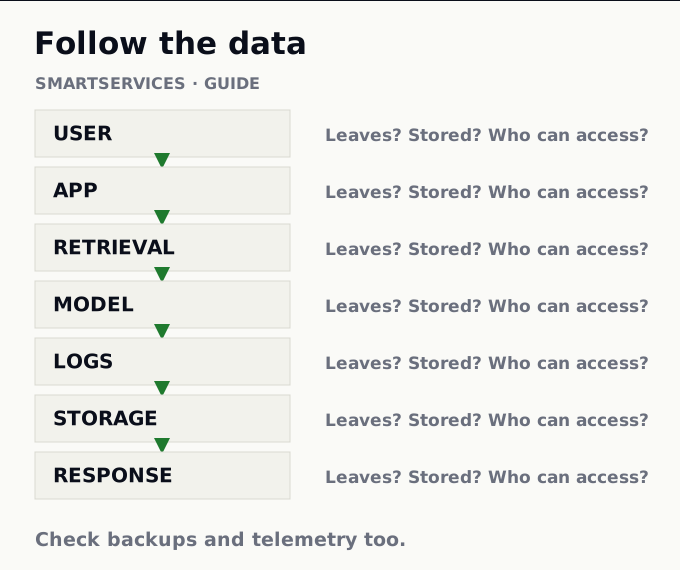
For every step—user → application → retrieval → model → logs → storage → observability → response—record four facts: what data enters, which service processes it, where a copy remains, and who can access it. Include prompts, attachments, retrieved passages, embeddings, outputs, and errors. Also inspect queues, caches, connected tools, and support access.
Hypothetical example: a user asks about a contract. The app searches a vector index and sends a passage to a model. The original PDF may stay inside the company, but the passage may leave. Follow the passage, not only the file. Check how long logs remain and whether a response can expose information to the wrong user.
Compare deployment models on their actual boundaries
| Model | What to verify |
|---|---|
| Public cloud API | Provider, region, retention, access, terms, and supporting services. |
| Private or dedicated cloud | Isolation, management, network, logs, and subprocessors. |
| VPC or private network | Egress paths, endpoints, identity, and services that remain external. |
| On-premises or local model | Operations, patches, hardware, backups, telemetry, and outbound connections. |
| Hybrid | Which data crosses the boundary and under what condition. |
NIST’s private-cloud definition allows infrastructure to exist off premises. Physical location and exclusive use are different dimensions. A model on a closed network still needs identity, permissions, updates, monitoring, and incident response.
Questions for architecture review
- Which personal, commercial, or sensitive data enters the workflow?
- Which outside components process text, images, audio, or metadata?
- What appears in logs, traces, indexes, and backups—and for how long?
- Who can access it: operators, providers, users, and connected tools?
- How are teams or clients separated, and how is data deleted?
- What changes when a model, connector, or provider is updated?
No single answer fits every organization. A cloud API may be suitable for nonsensitive work with adequate controls. Local deployment may be justified by data or connectivity restrictions, while shifting hardware and maintenance duties to the organization. Document the risk and the alternatives.
Mistakes that change the privacy picture
“Not used for training” does not necessarily mean “never stored.” Telemetry can include prompts. A shared document index may expose content across roles. Backups may outlive source files. A virtual private network does not make an external service local. Conversely, a poorly operated local system can carry more risk than a well-controlled cloud design.
Frequently asked questions
Does private AI mean on-premises?
No. The phrase can describe several isolation and control arrangements. Ask for a data-flow diagram and clear ownership.
Can a local model send data to the Internet?
Yes, through the app, tools, telemetry, or update process if those connections exist. “Local” describes only one component.
Are private cloud and on-premises the same?
No. A private cloud may be hosted elsewhere; on-premises describes physical location. Management and access still matter.
Can an external model be combined with internal data?
Yes, if the team knows exactly which passages leave, under what authorization and retention conditions.
How Smartservices evaluates the choice
Smartservices designs private AI and on-premises solutions around actual data and operating restrictions. We follow the data first, then choose an architecture. RAG and human review may be parts of it, but neither substitutes for access controls.