
Short answer
Retrieval-augmented generation (RAG) combines information retrieval with text generation. When someone asks a question, the system finds potentially relevant passages, supplies them as context to a language model, and generates an answer. Merely retrieving a document does not train the model on it. This distinction lets teams update accessible evidence without necessarily changing model weights.
In one sentenceRetrieval-augmented generation (RAG) retrieves relevant information and gives it to a generative model as context for an answer.
RAG retrieves; it does not automatically train the model
The pattern is search → evidence → context → answer. RAG does not make a model know everything. It lets the model consult information before responding. Both retrieval quality and generation quality matter.
Follow a question through the pipeline
- A user asks, “What does our return policy require?”
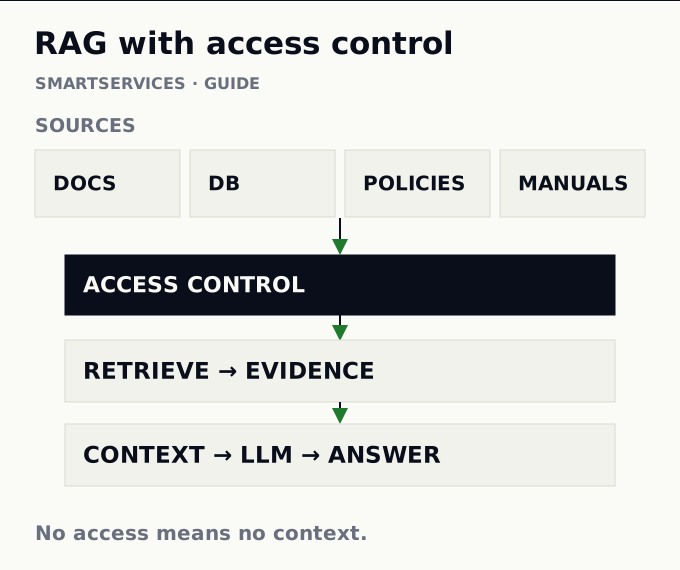
- The application checks identity and access rights.
- It searches approved documents, knowledge bases, or other sources.
- It selects relevant passages and may rerank candidates.
- It provides those passages to the model as context.
- The model answers, ideally with usable source references.
None of these steps guarantees truth. A retrieved passage may be stale or incomplete. A fluent answer can cite a document that does not support its conclusion. Test retrieval, answer faithfulness, and the system’s ability to say “I do not have enough evidence” separately.
Prepare the sources, not just the model
Many systems split documents into chunks for retrieval. Chunks that are too small can lose an exception’s context; chunks that are too large can crowd out better evidence. Titles, versions, dates, language, and permissions help filtering. PDFs, tables, and appendices may need document intelligence before they are useful.
Retrieval can use keywords, vector similarity based on embeddings, or both. An embedding is a numeric representation used to compare content; it is not a readable copy or a guarantee of meaning. Reranking tries to improve the order of candidate passages. The right method depends on the corpus and the questions people actually ask.
Access control belongs inside retrieval
Relevant content is not necessarily authorized content. Apply user permissions before a passage reaches the model, rather than hiding a citation after the answer is generated. Review shared indexes, caches, logs, and links back to original files. A public policy and a confidential contract can discuss the same subject; relevance and access are separate conditions.
RAG versus fine-tuning, search, and long context
| Approach | What it does | What it does not solve alone |
|---|---|---|
| RAG | Retrieves evidence for an answer. | Poor source quality or access controls. |
| Fine-tuning | Adjusts model behavior using examples. | Reliable access to changing documents. |
| Search | Returns results for a person to inspect. | A bounded, synthesized answer. |
| Long context | Allows more material in a request. | Selecting authorized, current material. |
These approaches can be combined. RAG does not require a vector database in every case. Keyword and hybrid retrieval can be stronger for exact terms. RAG is also not a transactional database. “How much stock is available now?” may require a live API rather than a document indexed yesterday.
When it helps—and when it does not
RAG is useful for policies, manuals, technical documents, and other changing knowledge when sources have owners, versions, and testable answers. It adds little to one short deterministic rule. It cannot repair contradictory source documents or guarantee real-time operational values. Fixing the source or the integration may matter more.
Frequently asked questions
Does RAG train the model on my documents?
No. It supplies retrieved passages as answer context. Training or fine-tuning is a separate operation.
Does RAG eliminate hallucinations?
No. It can ground an answer, but retrieval can miss evidence and generation can still overstate what a source supports.
Do I need a vector database?
Not always. Keyword search, filters, and hybrid retrieval may fit the corpus better.
Can RAG enforce user permissions?
Yes, if authorized evidence is filtered for each request before it reaches the model. Hiding a result only in the interface is insufficient.
Does it work with PDFs?
Yes, after usable content is extracted. Scans, tables, and mixed versions often need preparation.
How it fits a Smartservices solution
When a workflow needs answers grounded in company information, Smartservices examines sources, permissions, retrieval, and review before choosing a model. RAG may support document intelligence, private AI, or agents. It is a design pattern, not automatically a standalone product.