
Short answer
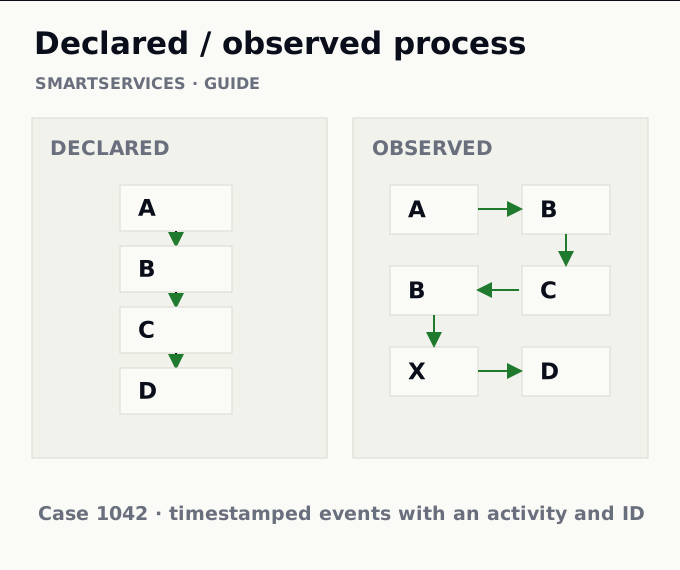
Process mining compares how an organization says work should run with the paths recorded by its systems. Event data grouped by case can reveal variants, waiting, loops, and rework. A purchase order may travel approve → return → correct → approve again, even though the official diagram shows one approval. Process mining cannot see activity that left no digital trace.
In one sentenceProcess mining uses event logs to discover, check, and improve how a process actually runs.
Start with the process you can observe
The declared process expresses intent. The observed process captures recorded execution. Neither tells the full story alone: logs can be incomplete, while a policy map can omit real exceptions. Their difference gives a team a concrete question to investigate.
Build an event log before building a map
Each event needs at least a case identifier, an activity, and a timestamp. In a hypothetical purchasing case, the identifier is PO-1042 and events say received at 09:14, verified at 09:18, returned at 11:42, and approved the next day. Amount, team, or channel may help explain variants, subject to appropriate access and privacy controls.
| Case ID | Activity | Time |
|---|---|---|
| PO-1042 | Received | Mon 09:14 |
| PO-1042 | Verified | Mon 09:18 |
| PO-1042 | Returned | Mon 11:42 |
| PO-1042 | Approved | Tue 10:05 |
A changing case ID breaks the sequence. Overwritten statuses hide steps. Unsynchronized clocks distort durations. In practice, preparing reliable events can take more work than drawing the resulting map.
Discovery, conformance, and variants
Discovery reconstructs common routes from logs. Conformance checking compares observed routes with a model or expected rule. Variant analysis shows alternative paths, including returns, skipped checks, and escalations. They are related but distinct questions.
A bottleneck may be a waiting period between activities rather than a slow activity. Separate active time, queue time, volume, and rework. A thick arrow on a process map does not tell you why a case waited.
Process mining is not a synonym for every process tool
A process map can be drawn from interviews. Process mining starts from execution data. Business intelligence can count orders and average time without reconstructing case sequences. Task mining often observes individual desktop actions. Robotic Process Automation (RPA) executes steps; it does not itself explain the process. A product may bundle these functions, but the methods remain different.
When the method helps—and when it does not
Hypothetical example: procurement believes approval takes four days. The log shows half the delay happens before the first check because vendor details are missing. The better change may be an input form and an integration, not an automatic signature. A redesigned workflow can then route exceptions.
If there are very few cases, no stable trace, and a different human judgment every time, interviews and observation may be more useful than a mining platform. Also avoid treating a slow variant as proof of a weak team. Harder cases may naturally take longer; event paths alone do not establish cause.
A practical readiness check
- Choose one question: waiting, rework, deviations, or compliance.
- Define where each case starts and ends.
- Check whether IDs remain stable across systems and timestamps are comparable.
- Inspect missing events, duplicate records, overwritten states, and permissions.
- Review the resulting routes with the people who do the work.
Frequently asked questions
Does process mining require AI?
No. Its core is event-sequence analysis. A product may add prediction or AI features, but a language model is not required.
Can one system provide enough data?
Yes, if it records useful cases and activities. End-to-end work often requires joining events from several systems and checking that join.
Does a discovered map show every case?
Not always. Visualizations often filter rare variants. State the time period, case population, and filters.
What should happen after finding a bottleneck?
Validate its cause with the team, change a step or condition, and measure again. Finding a delay is not the same as fixing it.
From evidence to a better operation
Before a complex process is automated, Smartservices looks for the real operating path. Event data can help distinguish redesign, automation, and systems integration. This guide describes a method; it does not imply an unpublished client implementation.