
Short answer
Forecasting estimates future values using available information and stated assumptions. “Prediction” is broader: it can describe a single event, a classification, or a future value. In operations, a forecast often describes a quantity over a horizon—next week’s demand, monthly purchases, or staffing load. It is not certainty.
In one sentenceA forecast estimates a possible future; a scenario changes an assumption; a decision selects an action; a plan executes it.
Forecast, prediction, scenario, and plan
A scenario asks what might happen if a condition changes. A decision chooses a response. A plan assigns actions and resources. They are connected but not interchangeable. A high-demand forecast does not buy materials by itself.
The forecast-to-plan loop
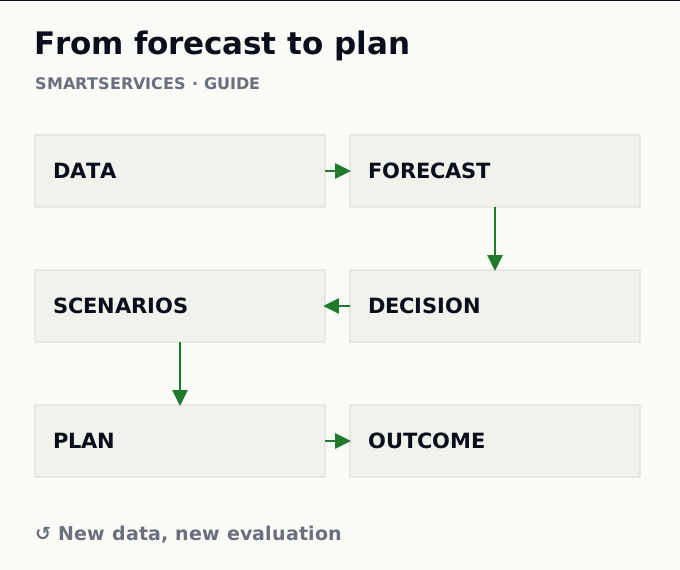
Data → forecast → scenarios → decision → plan → result → new data. The last step matters: once actual results arrive, compare them with expectations and learn. Without that loop, a dashboard can produce fresh numbers every month without improving decisions.
Hypothetical manufacturing example: order history and seasonality inform a demand forecast. The team calculates production and material requirements. A scenario asks what happens if a supplier is late. A decision may bring a purchase forward or accept greater stockout risk. The plan names dates and owners. The forecast does not replace capacity, inventory, or other operating constraints.
Forecast is not target or budget
A target is what the organization wants. A budget allocates resources. A forecast estimates what may happen under current information and assumptions. If the sales target is 10,000 units and the forecast is 8,000, changing the forecast to 10,000 does not close the gap. It creates a reason to discuss actions and alternative scenarios.
Uncertainty belongs in the answer
A single number can look like a promise. A prediction interval, when supported and calibrated, expresses a range of possible outcomes under assumptions. It cannot protect against every structural break. Uncertainty often grows with horizon; choose a horizon that serves the decision, not the most attractive chart.
External variables may help when they are known or can be forecast at decision time and add value out of sample. Using information only available later—data leakage—manufactures accuracy that production cannot achieve. New products, price policies, or disrupted markets can break historical patterns. More old observations do not automatically repair a new regime.
Evaluate the forecast as it will be used
- Define the decision, update frequency, and horizon.
- Compare with a reasonable naive baseline, not just historical fit.
- Respect time in testing; use rolling or held-out periods.
- Inspect error by product, period, and horizon, not one average.
- Monitor bias, missing inputs, changing conditions, and interval quality.
A small error does not prove a variable causes the outcome. Changing a model input for a what-if exercise does not prove intervening on that variable will produce the modeled result. That distinction matters before investment or purchasing decisions.
Measure process time separately from model accuracy
In a published Smartservices case, gathering and processing information for a monthly production and purchasing forecast changed from approximately 11 days to about one minute. That is the documented process-time result. It does not claim better forecast accuracy or the same outcome elsewhere. Faster preparation can leave more time for scenario review and judgment.
Frequently asked questions
Is a forecast a promise?
No. It is an estimate conditional on data, method, horizon, and assumptions. Update it when information changes.
How does a forecast differ from a plan?
The forecast estimates a possible result. A plan specifies chosen actions and resources in response.
Can a correlated variable support any scenario?
No. A scenario can explore assumptions, but historical correlation does not show that changing the variable causes the outcome.
Do more variables always improve a forecast?
No. They may add noise, require unknown future values, or leak later information. Test their value out of sample.
Planning around real work
Smartservices connects forecasting and planning to data, decisions, and the operating workflow. Automation may shorten preparation; predictive quality must be evaluated separately. The goal is a decision the team can make and revisit.